Sadhana - The Benefits of Remembering
By Karla Becker (Sat Bachan
Kaur), published in “Branches Magazine” September –October 2003 |
|
|
Rise and shine! The early morning hours before the world awakens are known as the Amrit Vela – the Ambrosial Hours. These are the ideal for a spiritual practice that leads you back to what is important in life. In Sanskrit the practice is called sadhana, which means “wealth.” Having a personal sadhana has been likened to having a spiritual bank account. In Shakti Parwha Kaur Khalsa’s book, Kundalini Yoga – the Flow of Eternal Power, she says that sadhana “is the best investment in the world. It will always earn at least ten percent interest. For every hour of morning sadhana, you get ten hours of guidance and clarity!” Giving 10 percent of your day – roughly two and a half hours - to a spiritual practice gives you spiritual wealth to last an entire day. Early morning sadhana hours are usually from 4 to 6:30
a.m. This silent time before the
world wakes up allows you a still space to remember who you are. Two and a half hours may seem like a long
time for a spiritual practice. Any
amount of time in the morning, though, can be a good start. Setting your clock back half an hour to
provide time for a spiritual practice can reap tremendous benefits. If nothing else, it requires intention and
discipline to let go of that extra half hour of sleep in favor of
reconnecting with your highest inner self and remembering who you are beyond
your every day responsibilities. It
is so easy to get caught up in the routine of life and forget that it has a
higher purpose than running around taking care of deadlines and errands. Who you really are is not defined by the roles you have
in life, such as “mother,” “wife,” or “employee.” Who you really are is also not defined by the difficulties you
may have gone through, such as surviving a deadly illness, losing a loved one
or having suffered a divorce. Even
the good experiences in your life, like finally graduating from college,
winning a promotion, getting married, buying your dream home or becoming a
parent, do not define the real you.
Remembering who you are as the truth is what you really are about: a
beautiful soul with an infinite potential. A mantra to remind you who you really are at your core is
Sat Nam, translated as “Truth is my identity.” It is a base mantra used in the practice
of sadhana in the Kundalini Yoga tradition.
It is a reminder of who a person is as the truth, recognizing the divine
consciousness in an individual. It is
also used as a greeting in the communitiy practice of sadhana, recognizing
the divinity in every individual. Yogis throughout the ages have experienced sadhana as a
way to deepen their connection with themselves and with the infinite. Yoga practitioners today continue this
experience, both individually and with a community. As well as being a personal spiritual practice, sadhana is equally
about building a community. People
come together to share a common bond with like-minded individuals and can
then go out and share their experience with others. In Bloomington, a community of Kundalini yoga students comes together to practice early morning sadhana every day from 3:45-6:15 am. The sadhana is conducted at the Ram Das Room, which is located down the hall from the Lynda Mitchell Yoga Studio on the north end of the square in downtown Bloomington. Usually two or three individuals attend, along with a leader of the sadhana. The Ram Das room is a serene comforting place. It has the feeling of being in an ashram. In the early morning the room is lit with candles, and incense fills the air with a sweet, musky scent. The floor is carpeted with colorful oriental rugs, and plants and spiritual artifacts adorn the room. |
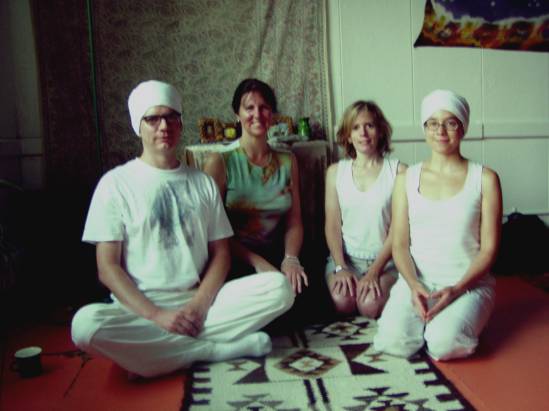
Mahan Kalpa Singh (Paul) Mahern, Sat Bachan Kaur (Karla Becker), Lori Heath, and Karta Kaur (Elise) Hassler after early morning Sadhana. Photo by Diane Hancock. I attended sadhana one morning recently, along with two
friends, Diane Hancock and Lori Heath.
The leader of sadhana that day was Mahan Kalpa Singh (Paul) Mahern, a
teacher for the Bloomington Kundalini Yoga Cooperative. Also in attendance was Karta Kaur (Elise)
Hassler, who conducts sadhana on a rotational basis with the other Bloomington
teachers. The practice of sadhana in
the Kundalini Yoga tradition is the same throughout the world, as taught by
Yogi Bhajan. The class began with a
reading from the Jaapji, a powerful, graceful long chant in the lanuguage of
Gurmukhi, a derivative of Sanskrit. A
yoga set followed, then a brief relaxation, then a sung meditation using a CD
with seven mantras, which are chanted every day. The leader read an inspirational passage during the final
minutes. As sadhana progressed, the
room grew lighter from the rising sun.
By the time we finished, the space was glowing with sunshine. We shared yogi tea and felt bonded by our
group experience. The bright sun and
the sweetness of the early morning hours left a positive impression as we
dispersed to begin our everyday routines.
We parted cheerfully: Sat Nam!
Although
the two and a half hours in the early morning are ideal to practice sadhana,
you can benefit from any time you take out of your day to devote yourself to
a spiritual practice. Setting a corner
of a room aside with some items that have special meaning to you, such as a
prayer rug, pictures, religious icons, meditation shawl, or other meditation
items, can intensify your experience.
Try to practice in a group at least occasionally in order to benefit
from the shared energy.
~~~~~~~~~~~~~~~~~~~~~~~~~~~~~~~~~~~~~~~~~~~~~~~~~~~~~~~~~~~~~~~~~~~~ Karla
Becker is a student and teacher of Kundalini Yoga in Indianapolis. She is a certified yoga instructor as
recognized by the Yoga Alliance. Email
her from karlayoga.com or at karla@karlayoga.com. Update: the Bloomington Sadhana is now being conducted in the Kundalini Yoga Ashram, located at 325 S. Rogers Street. For more information about the Bloomington Sadhana, visit the Bloomington Kundalini Yoga Cooperative. For more information about the practice of sadhana, visit kundaliniyoga.com |