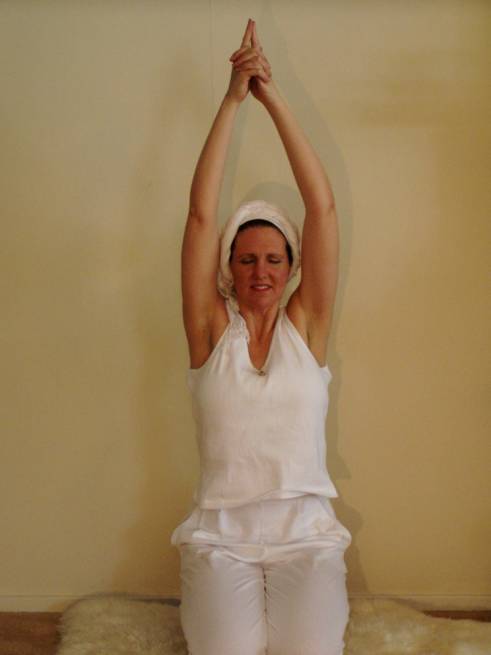
Kundalini Yoga
|
|
|
By Karla Becker (Sat Bachan Kaur), published in “Branches Magazine” March –April 2003 |
|
|
Yoga has been a hot topic around the health clubs for some
time now. Athletes are turning to
yoga to help them with their flexibility.
Others look to it for helping them achieve their fitness goals. However, recent newspaper and magazine
articles have warned about the potential pain of yoga’s physical aspect,
particularly in power yoga. And well
it should. When yoga is practiced for
the physical aspect alone, especially by those who might be doing yoga in the
same way as doing an aerobics class, it is not yoga, but calisthenics. Although Kundalini Yoga is quite physical, its main benefit is derived from the inner experience. Devta Kidd, Kundalini Yoga instructor in Bloomington, says that practicing Kundalini Yoga has given her “the ability to step back away from myself and from this existence and view it all from a non-dramatic perspective. I don't get that perspective all the time – not even most of the time – but the more I practice, the more consistently I am in that state of awareness.” Kundalini Yoga is relatively new to the United States,
having been introduced to the West Coast in 1969 when Yogi Bhajan arrived
from India and founded 3HO (Healthy, Happy, Holy Organization). This was the first time that Kundalini
Yoga was taught openly. It had been
considered a secretive form of yoga, to be taught only to a high caste in
India, the Brahmans. Yogi Bhajan felt
that it was needed in the United States to provide young people of the era an
alternative to consciousness-altering drugs.
Devta describes Yogi Bhajan’s introduction of Kundalini Yoga as a way
out for those using drugs to “help detox their systems, get their glands
working properly again, strengthen their nervous systems, and increase their
self and universal conscious awareness." How is it similar to other forms of yoga? Like other yogas, it links movement with breath. The way it differs is its direct focus on moving energy through the chakra system, stimulating the energy in the lower chakras and moving it to the higher chakras. The chakras are energy centers, seven in total, located
beginning at the base of the spine and ending at the top of the head. An eighth chakra exists in Kundalini Yoga,
which is the electromagnetic field, sometimes called “aura.” The aura is thought to be strengthened
through the practice of Kundalini Yoga. As Shakti Parwha Kaur Khalsa describes in her book, Kundalini Yoga: The Flow of Eternal Power, “We practice Kundalini Yoga in order to balance and coordinate the functions of the lower chakras and to experience the realms of the higher chakras. After the kundalini energy rises and becomes accustomed to flowing freely through all the chakras, there is a definite change of consciousness, a noticeable transformation in the character of an individual. The person looks at life differently, feels different and therefore acts differently. The real “proof” that someone’s kundalini has risen lies in the upgrading of that person’s attitude toward life, his relationships with other people and with himself. |
Like other yogas,
Kundalini links movement with breath.
Kundalini Yoga awakens the
|