The Chakras –
Your Path to Inner Harmony
By Karla Becker (Sat Bachan
Kaur), published in “Branches Magazine” May –June 2003 |
|
|
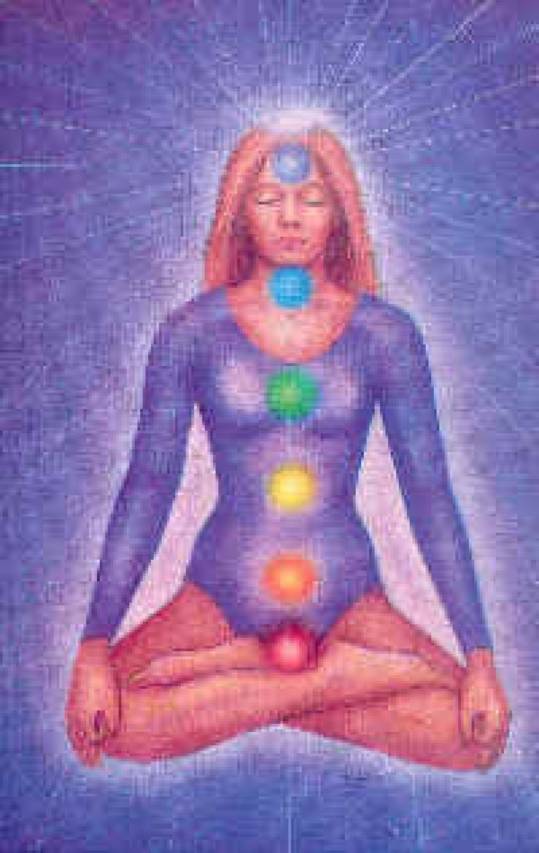
Chakra is a Sanskrit word for “Wheel.” The chakras are spinning wheels of energy in the body, according to yogic philosophy. Because chakra is a term from yogic philosophy, it sounds esoteric. To the contrary, your chakra system is as important to you as the air you breathe, the food you eat, and the water you drink. Having a healthy chakra system is basic to your physical, mental, and spiritual health. The chakra system can be likened to Abraham Maslow’s Hierarchy of Needs. The hierarchy was depicted as a pyramid from which a person can achieve transcendence. At the base of the pyramid are security needs. If those needs are not met, then the person stays stuck in trying to fulfill security needs. As the security needs are fulfilled, the person moves up the pyramid to love and belongingness needs. As those are fulfilled, the person moves up to the top of the pyramid at which point self-actualization and transcendence can occur. In the same way, when you have fulfilled the needs of your lower chakras, you are able to move up to the realms of your higher chakras and achieve self-actualization and transcendence with the infinite. To be physically healthy, the lower three chakras need to be in good working order because they are basic to your physical functioning, relating to the organs of elimination, reproduction, and the digestive system. When the lower chakras are in good working order, you feel healthy and can move to the higher chakras The lower chakras begin at the base of the spine, the sacrum, with the first chakra, muladhara. It is the seat of your eliminative system, where your colon and bowels reside. This chakra is focused on stability and security. When you have a strong first chakra, you have a feeling of safety and are comfortable in your own skin. When it is weak, you have poor elimination, feel stuck, and are fearful or anxious. A common ailment for the eliminative system is irritable bowel syndrome. Your first chakra is critical to having a good sense of well being. The second chakra, svadisthana, is located at the lower lumbar region. It is the seat of your reproductive system, where your sex organs reside. When you are strong in your second chakra, you feel creative and passionate. If the second chakra is weak, you have poor sexual health. A common resulting ailment could be impotence or prostate problems for |
|
|
men. In women, it could be endometriosis, PMS, or other “female” problems. The third chakra, manipura, is located at the upper lumbar region of your spine, where your digestive organs reside -- your liver, spleen and stomach. These important organs are powerful, and so is this chakra. Also called the Solar Plexus or Navel Center, it is the center of mental and physical energy. When you are strong in your third chakra, you have vitality, are goal-oriented, and have a powerful projection. When you are weak in this chakra, you suffer from digestive disorders, lack energy, and feel listless. Moving into the upper half of your body, which relates to the upper half of Maslow’s pyramid, are the chakras of the heart, throat, brow, crown, and aura. The fourth chakra, anahata, is where your heart resides, located at the thoracic region of the spine. It is your seat of compassion and love. When you’re strong in your heart chakra, you feel a connection with the world around you, feeling love and compassion for your fellow human beings and living creatures. A weakness in the heart chakra could result in an ailing physical heart, as well as a feeling of disconnectedness and a lacking in compassion and trust for others. The fifth chakra, vishuddha, is where your throat resides, located at the cervical spine. It is your seat of communication. When you’re strong in your throat chakra, you feel that you are heard and can communicate your ideas effectively. A weakness in the throat chakra could result in throat disorders, speech problems, and the feeling that your words have no meaning.
|
The sixth chakra, ajna, is your seat of intuition. It resides between your eyebrows. A powerful gland, the pituitary gland, resides at this chakra. The pituitary gland controls all the glandular functions in your body, for example, the thyroid at the throat and the thymus at the heart. When your sixth chakra is powerful you feel intuitive and have an inner knowing. When it is weak, you may suffer from migraines and feel disconnected from yourself. The seventh chakra, sahasrara, is at the crown of your skull. It is your connection to the infinite, whatever you conceive the infinite to be. When you have a strong connection with the infinite, you feel detached from circumstances. You are no longer externally referenced, reacting to events around you, but feel transcendent and at one with the universe. When your seventh chakra is weak, you lack a spiritual base in your life, feeling that life is meaningless and reactionary. An eighth chakra exists in Kundalini yogic philosophy, which is your aura, the electro-magnetic field around your physical body. Persons with strong auras have physical health and success. This success is not identified by money or prestige, but by a feeling of inner harmony and being at one with your mind, body, and spirit. How can you strengthen your chakras? You can practice yoga and meditation, which are beneficial to strengthening your mind, body, and spirit. A style of yoga that focuses directly on strengthening the chakra system is Kundalini Yoga. Kundalini Yoga focuses on balancing and coordinating the functions of the lower chakras in order to experience the realms of the higher chakras. By raising kundalini energy, which resides in the spine, the chakras are strengthened. The Chakras are the wheels within us, which, when strong and healthy, allow us to achieve inner harmony and transcendence. Good books, which focus on the chakra system and the practice of Kundalini Yoga include The 8 Human Talents, Restore the Balance and Serenity Within You with Kundalini Yoga, by Gurmukh and The Kundalini Yoga Experience: Bringing Body, Mind, and Spirit Together by Dharam Singh. Karla
Becker (Sat Bachan Kaur) is a student and teacher of Kundalini Yoga in
Indianapolis. She is a certified yoga
instructor as recognized by the Yoga Alliance and can be emailed from
karlayoga.com or at karla@karlayoga.com.
For more information about Kundalini Yoga, visit the Bloomington KY Cooperative and 3ho – Healthy, Happy, Holy Organization
|